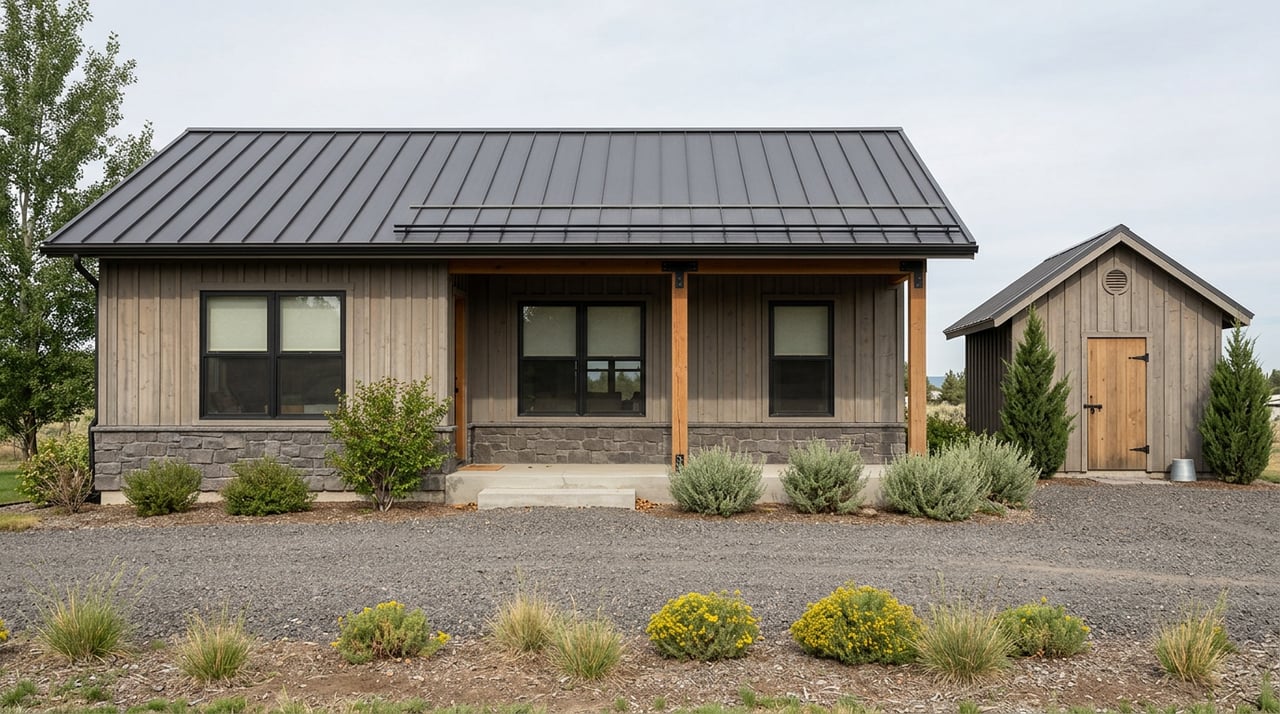
A Ridgway mailing address is a postal convention, not a service map. Two parcels a mile apart on the same county road can carry different septic obligations, different road-maintenance burdens, different well limits, and different water rights. The listing photos will not tell you which is which. Neither will the seller's property description.
The transaction risk on a rural Ridgway parcel isn't the well or septic itself. It's that the records that govern them live in four separate offices, and a standard inspection period isn't long enough to reach all four unless you sequence the calls in the right order.
That is the argument of this post. Everything below is evidence for it.
Four offices, one deadline
When you go under contract on acreage outside town limits, you are not really buying a house. You are buying access, an on-site wastewater system, a well permit, and some combination of surface and groundwater rights. Each one is administered by a different body:
- Ouray County Land Use Department at 111 Mall Road in Ridgway handles OWTS permits, building permits, driveway approvals, and Colona-area wildfire review. The county requires all plans for building or septic permits to be submitted in electronic PDF format, and payments are processed through Cloud Permit.
- Ouray County Road & Bridge classifies the access. An access road serving only one or two lots is a driveway; three or more housing units make it a road, and different design standards apply to each.
- Colorado Division of Water Resources issues and records well permits and administers water rights through the local water commissioner. DWR says complete applications for new well permits may take up to 49 days to review.
- Colorado Water Court holds the decrees, changes of use, and augmentation plans tied to a parcel or its ditch.
If your inspection deadline is 14 days and you start by scheduling a home inspector, you will run out of time before you hear back from three of these four. The rest of this post is about what to ask each of them, and in what order.
Access is the fact that gates everything else
Before the well test, before the septic pump-out, before the water-rights conversation, verify the road. Access is one of the first things to verify because it affects daily use, construction planning, and winter reliability.
Three questions do most of the work:
- Is the road town-maintained, county-maintained, or private?
- If private, is there a recorded maintenance agreement, and who has been paying?
- Does the driveway meet current county standards, or is it grandfathered?
The last question matters more than buyers expect. If your lot does not have access that meets minimum standards, you may not be able to get a building permit. A parcel with a beautiful cabin footprint and a driveway that won't support a fire-code turnout is a parcel where your next addition is a legal problem. The county planner will answer this on a phone call. Make the call in week one.
There is a second access issue that surprises out-of-state buyers. Property owners should be aware that historic public access routes may exist on or across their property, and these routes cannot be gated or otherwise closed to public access. If you were planning to fence a driveway that was historically a two-track to the National Forest, ask the title company to flag it.
The septic file you should already be reading
If a home is on OWTS, the seller should be able to produce a permit file. If they cannot, that is data.
Public sewer service is not available in most of unincorporated Ouray County. Only the Town of Ridgway, the City of Ouray, and the Fairway Pines Sanitation District offer such services. Everywhere else is on-site, and everywhere else is governed by Colorado's Regulation 43, with counties handling permitting for systems with flows of 2,000 gallons per day or less.
What you are looking for in the file:
- An engineer-stamped design. OWTS systems must be designed and percolation tests performed by a licensed professional engineer.
- A Site/Soil Evaluation on file with the county.
- A final inspection signoff. The county must inspect the installed system before backfilling, so the practical step is to ask for the septic permit file and confirm the final inspection and soil evaluation are in place.
- Setbacks that still work. The county states the setback from a septic tank or soil treatment area to a lake, watercourse, irrigation ditch, stream, or wetland is 50 feet. If the parcel has a ditch running through it, walk the ditch and pace the setback yourself.
The parcels that generate late-inspection surprises are the ones with additions, guest cabins, or barns added after the original OWTS was designed. A three-bedroom design does not silently upgrade itself when someone adds a fourth bedroom over the garage. Ask the county whether the current use matches the permitted design.
What a well permit tells you, and what it doesn't
The well permit is the easy document to obtain and the easy document to misread.
Colorado's domestic exemption is the anchor. The domestic well exemption commonly allows up to 15 gallons per minute and 1 acre-foot per year for a single household under CRS 37-92-602(4)(a). That sounds generous until you read the fine print. Exempt wells have strict limits and do not automatically cover multiple dwellings or expanded uses. A guest cabin on the same parcel, a second residence for family, or an expansion of irrigated area can quietly push a well outside its permit.
The permit tells you what the well is legally allowed to do. It does not tell you what the well actually produces. For that, you need the well log and a current pump test. Depth in this part of Colorado varies widely, and the useful number for a buyer is not the total depth but the static water level and how quickly the well recovers under load.
A few verification steps that cost almost nothing:
- Pull the well permit number from the seller's disclosure and search it directly through DWR's public well-permit database.
- Ask for the original well log and any subsequent pump tests.
- If the parcel has more than one structure, confirm each structure's water source in writing. Many small acreages use domestic exempt wells when permitted, and shared wells appear in rural subdivisions and raise issues around ownership, capacity, and maintenance.
Shared wells deserve a paragraph of their own. If the parcel draws from a shared well, the operating agreement should be recorded and should specify cost sharing, priority of use during low-flow periods, and a mechanism for replacing the pump. If there is no written agreement, the "shared well" is really a handshake, and handshakes do not convey.
The sentence that costs people money
Under Colorado law, water is severable from the land.
That single sentence explains most of the water-rights disputes that surface after closing on Ridgway acreage. A property can be listed with irrigated hay meadows, historic ditch use, and a set of shares in a mutual ditch company, and the water can still not convey. Shares can be detached from the land, so confirm whether the sale includes them and how they are conveyed.
What you want the title company and the seller to produce:
- The deed history for any ditch shares, storage rights, or well easements.
- Ditch company assessments, receipts, and rotation schedules.
- Any augmentation plan, change decree, or Water Court case tied to the property or its ditch.
The Uncompahgre system context matters here. Ridgway Reservoir and other storage projects influence seasonal releases and downstream deliveries on the Uncompahgre system, and storage water rights are distinct from direct diversion rights with their own decreed uses, capacities, and priorities. A seller who says "the property has water" may be referring to a storage allocation, a ditch share, a domestic well, or all three. Get the specific instruments in writing before you release inspection.
The augmentation piece surfaces when a buyer wants to do more than the parcel currently does. New wells or expanded pumping that could injure senior surface rights often require an augmentation plan, which replaces depletions so junior uses can continue during shortages. If your acquisition thesis includes a second dwelling, a horse operation, or an irrigated garden larger than what the current permit allows, price augmentation into your offer, not into a post-closing regret.
Sequencing a fourteen-day inspection window
The point of walking through the four offices is that the sequence is not obvious, and the sequence is what makes the deadline work.
- Days 1 through 2. Pull the well permit from DWR and the OWTS permit file from Ouray County. Confirm the parcel's legal creation status with the county planner if it is under 35 acres. Ouray County says parcels under 35 acres may still be buildable if they were legally created, but buyers should check with the county planner before purchasing.
- Days 2 through 4. Order the well flow test, the septic pump-and-inspect, and the water panel. These are three separate vendors and each has a lead time.
- Days 3 through 5. Ask the title company for the ditch-share conveyance history, any recorded shared-well or road-maintenance agreements, and any augmentation plan or change decree.
- Days 5 through 8. Walk the setbacks. Pace the 50 feet from the septic components to every watercourse and ditch on the parcel. Photograph the driveway approach and confirm the classification with Road & Bridge.
- Days 8 through 12. Review the well log and pump-test results with an engineer or well contractor, not with the seller's summary.
- Days 12 through 14. Convert findings into negotiation. Failed items rarely kill a purchase; unpriced items do.
The buyers who close cleanly on Ridgway acreage are almost always the ones who started making phone calls the day after the contract went binding, not the ones who waited for the home inspection report.
A short FAQ
Does a Ridgway mailing address mean I'm on town water and sewer? No. A Ridgway mailing address does not tell you how a property is served. Inside the Town of Ridgway, public works handles streets, snow removal, water, and sewer. In unincorporated Ouray County, utilities may be town-based, privately provided, well-based, or tied to private access.
If I'm buying an existing home, can I skip the well and septic review? No, but timing is easier. One practical advantage of buying is that in many cases you may be able to close and move in without going through the county's full building-permit sequence, well-permit review, inspection schedule, and certificate-of-occupancy process. The diligence still runs; the permitting doesn't.
Do ditch shares automatically transfer with the deed? Not always. Water is severable from the land, and share conveyance has to be documented in the closing paperwork. If it isn't spelled out, assume it isn't included.
What if I want to add a second dwelling later? Ask the augmentation question now. A domestic exempt well's limits do not stretch to cover a second household without additional permitting, and in an over-appropriated basin that permitting can require a court-approved plan.
Rural Ridgway is a rewarding place to own, and the four-office problem is a solvable one when the sequence starts on day one. If you are under contract, or looking at parcels and want a due-diligence checklist tailored to the specific property, reach out to Telluride Mike. Buyer representation on rural Western Slope transactions is where the water-policy background earns its keep. Start Your Telluride Search.